Sunday, 17 March 2013

Ski touring Fionn Bheinn (Achnasheen)

Approaching the summit of Fionn Bheinn
Ask a child about their ambitions and they will tell you that they want be an astronaut or a Formula 1 driver. As I age my ambitions become increasingly mundane and attainable. One was achieved on Saturday, the ski descent off the back of Fionn Bheinn. The last time I toured this hill, back in 2009,  I had chased down a post-holing snowboarder named Davie. When I caught up with him on the summit he decided that he should buy himself a split-board. This is a common theme among snowboarders of a certain age, who suddenly realise the limitations of their chosen snowsport. At the time I was hampered by ill-fitting second hand equipment and an inability to ski powder, so when Davie blasted off down the back I didn't join him, knowing that it would require all my energy to retrace my route of ascent. 

Summit view to Fisherfield
On Saturday I left Inverness with the intention of skiing either Ben Wyvis or Fionn Bheinn.  The hills to the north were plastered in snow and bathed in sunshine, inducing me to whoop with excitement. A thin veil of cloud often envelops the summit of Wyvis as the day progresses and I've yet to ski it in wholly clear conditions, so when I spotted an ominous layer of cloud lurking to the south I decided on Fionn Bheinn, reasoning that its slightly lower summit would remain clear for longer. At that point I remembered the run off the back that I had missed on 2009 and resolved to sample its delights, both skills and equipment having improved in the intervening years.

Fresh tracks and ominous cloud
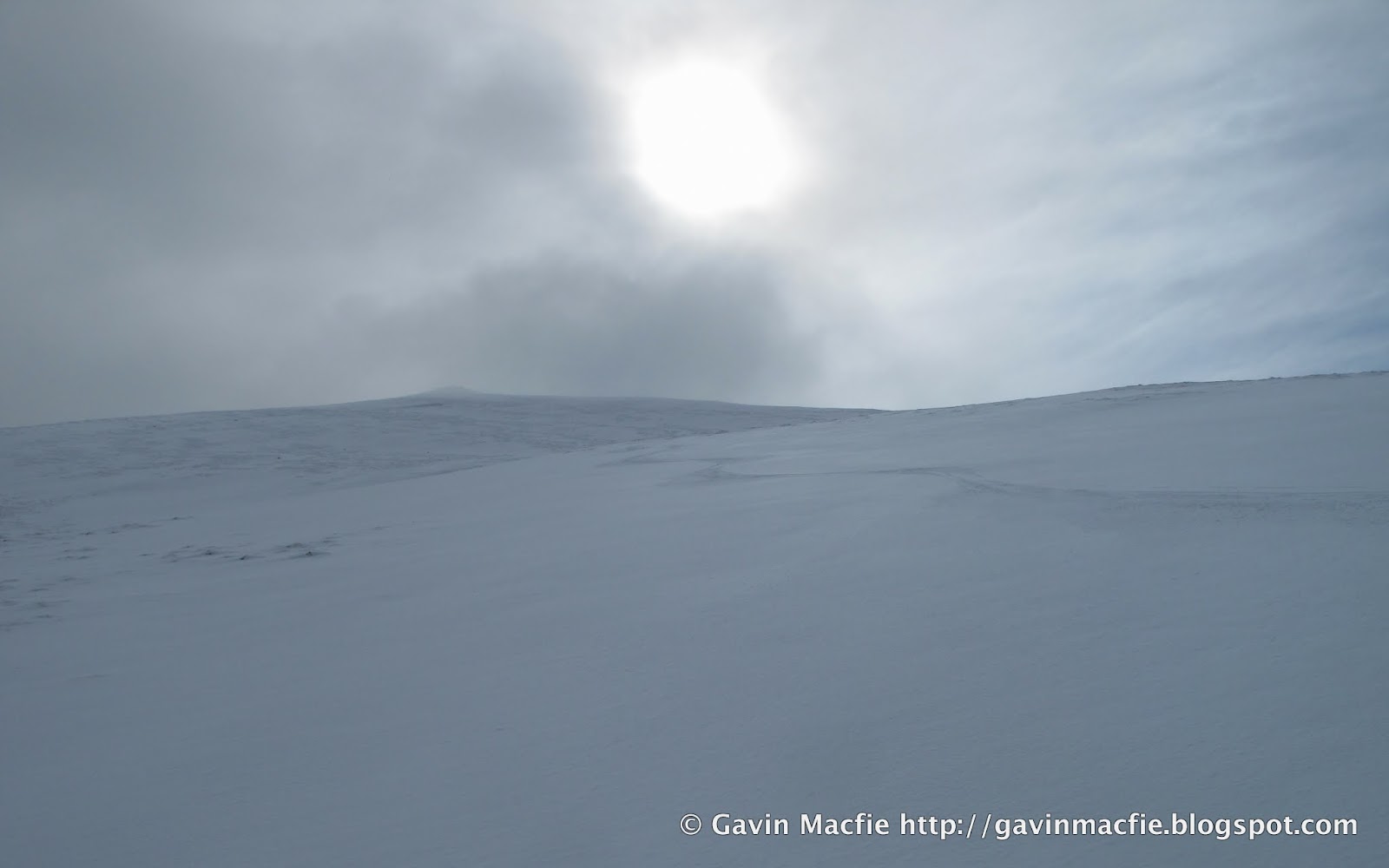
In the end it stayed clear for just long enough. After briefly savouring the summit views north to Fisherfield I enjoyed a fabulous ski descent, linking powder-filled depressions in the open slope. It was so good I decided to skin up and have another shot, but alas the first whisps of cloud were starting to curl over the summit and the visibility deteriorated steadily over the 30 minutes it took me to ascend. I lingered on the summit over lunch and coffee, hoping that the cloud would clear. Unfortunately it didn't and I descended haltingly in the flat light, delighted that I had managed that one superb run before the weather changed.

Skis off time

Labels: , ,

Thursday, 3 May 2012

Cairngorms: Overnight ski mountaineering trip


Coire an t-Sneachda

The fickle nature of Scottish winter conditions has been beautifully illustrated by this season. It got off to a promising start, but a thaw over Christmas took its toll and despite some further snowfall it all ground to a halt at the end of February, the earliest end to a season since lift-served snowsports began 50 years ago. I gave up and went skiing in France at the end of March. When I returned I waxed my skis and put them in the loft. That did the trick. The snows returned in late April, and they kept coming, allowing deep snow cover to build up over the Cairngorms. People always express surprise at April snowstorms, but they are are in fact a normal and reasonably predictable part of our weather, so much so that they have long been known in agricultural circles as 'lambing storms' for their propensity to appear, inconveniently, at the same time as the year's delicate crop of lambs.

What was unusual about this year's lambing storms is that they culminated in a week or near-constant snow over the tops before giving way to a weekend of sunshine. What's more this was not just any weekend, it was a weekend that had been reserved, months in advance, for outdoor sport. I had hoped that it might be spent be camping by a crag, climbing sun-kissed rock by day and drinking round the campfire by night, but this was not to be.

There could only be one choice of activity given the conditions, an overnight ski mountaineering trip taking in the big four tops of the Northern Cairngorms, Cairngorm itself, Ben Macdui, Carn Toul and Braeriach. I had first embarked on this route six years ago, almost to the day, when I'd only been skiing for a year. On that occasion  we decided to truncate our round by overnighting in the Garbh Coire Howff and accessing the Braeriach plateau via Garbh Coire Mor, missing out Carn Toul and Angel's Peak. Part of this decision had been driven by a reluctance to spend the night in the Corrour bothy, at the time notorious for overcrowding, mice and for being located in an area festooned with human excrement. All has changed since then, the bothy is now a cosy wee place, wood-lined with a stove and sleeping platform bunks. In order to address the jobby issue a composting toilet has been installed in a wooden outhouse. 

Pete, Stu and Colin on the steep section at the top of Allt Clach nan Taillear. Avalanche debris to the left.

After a couple of runs on the horrifically crowded piste we struck off from Cairngorm summit at at around 1300 hrs, bound for Ben Macdui. Reliable snow cover makes the jaunt to Macdui and back by far the most popular ski tour in Scotland, but it is most certainly not one of the best. The terrain is too flat, and flat terrain is the least enjoyable for touring on alpine kit. In truth lighter weight nordic gear is a far better choice for this particular tour, obviating the need to repeatedly affix and remove climbing skins. While such lightweight kit is advisable for the skier whose ambition is to bimble on the plateau, it is not the best choice for ski mountaineers seeking what the admittedly rather dated SMC guidebook describes as 'one of the finest and most challenging ski-runs in the Scottish mountains', the descent of the Tailor's burn (properly Allt Clach nan Tailler, the burn of the Tailor's Stone). My previous descent six years ago was a trying and exhausting one, the snow was heavy and the visibility was poor. This year it was revelatory, a pleasant glide on beautiful snow with the sun on our faces. I have been concentrating on improving my skiing this season and it had paid off, I'm now capable of enjoying skiing black with a pack.

Corrour Bothy and the Devil's Point

A light pack is critical for touring, but the activity itself requires so much equipment; shovel, avalanche probe and transceiver, skins and harscheisen, that I was unable to get the starting weight of my pack below 11.25 kg, including all overnight kit, food, camera and half a litre of water. Our packs were lighter back in 2006 because we didn't have any avalanche safety equipment, not that the spring conditions required them. This year, after a week of snow, it would have been rash to leave the safety gear in the car. In truth I am dubious of the benefits of transceivers in Scotland, having heard neither of anyone being saved due to having one nor of anyone perishing through the lack of one. For this trip I left crampons at home, unwilling to carry a kilo of ironmongery that wood almost certainly remain in my bag, reasoning that I could cut steps with an ice axe should I find myself on steep, icy, unskiable ground. I am glad that I didn't have to cut any steps and am now very tempted by lightweight crampons, the best of which are under 300 g. But perversely, investing in lightweight crampons would increase rather than decrease the weight of my pack, for I would actually carry them rather than leaving them at home.

The ice axes did come in handy at Corrour, where we found, to our surprise, a substantial log, over 2 m long and about 15 cm diameter. A previous visitor must have carried it in, hoping to find an axe or saw in the bothy with which to process it into stove sized lengths. We spent a at least an hour and possibly more taking turns at hacking away at the log, covering the surroundings in wood chips as if a group of beavers had picniced outside the bothy. There were three other residents who were, I think, rather bemused by the this prolonged bout of frenzied hacking. They seemed glad enough of the resulting fire though.

I was delighted to get a chance to inspect the famous Corrour toilet, an ingenious contraption that has two seats side by side. I didn't actually use the facilities, a surprising omission that I attribute to too consuming much oatmeal and not enough beer. At first it appears to have been designed with tandem crapping in mind. However on closer inspection it became clear that only one was in use. I recall reading somewhere that the toleys fall into a sack. Only once the sack is full and the hatch battened down to allow the composting process to take hold does the second seat come into play.

The day in prospect from the summit of the Devil's Point
The distant Southern Cairngorms, Carn a'Mhaim, Angel's Peak and Lochan Uaine from near the summit of Braeriach

It was wonderfully exhilarating to start another blue sky day out in the heart of the wilds of the Cairngorms.  I was outside with my porridge waiting for the sun's warmth to sweep down the flanks of the Devil's Point towards the bothy. I was the only member of the party who had any enthusiasm for starting the day with an ascent of the Devil's Point and so I strapped my skis to my pack and set off half an hour ahead of the rest of the party, ascending from the boreal spring into Scotland's island of Arctic tundra, the Cairngorm plateau. From the summit the day's sport was laid out before me; the peaks of Carn Toul, Angel's Peak and Braeriach are well defined and each provides a worthwhile ski run from its summit. The snow level was 700 m, reaching down to the high point of the Lairig Ghru. The transition between deep skiable snow and heather was a sharp one. The relatively high snowline accentuated the contrast between high and low ground, the col connecting Carn a'Mhaim and Macdui was highlighted beautifully. The distant peaks peaks of the northwest stood proud against the foreground of a practically snowless Monadhliath. The northerly Munros, Ben Mor Assynt  and Ben Klibreck,  were clearly visible, a full 80 miles to the North, as was the full length of the Caithness coast. Also clearly highlighted was the path of the Dee, the glen of which separates the northern and southern Cairngorms. 
Content after two runs of fresh tracks down Coire Gorm on the the best snow of the year
Approaching the teetering torture of the Chalamain Gap
There was a price to be paid for the wonderful descents from Sron na Lairig into Coire Gorm (it was so good we skinned up for another run), the walk out. We managed to ski to the lip of the Lairig Ghru but thereafter had to strap our skis to our packs, grit our teeth and dig deep for the descent into the gorge below, then the ascent to the torturous bouldery bed of the Chalamain Gap, a glacial meltwater channel carved in times past by vast volumes of melt water released by the Strathspey Glacier. We teetered our way through on empty legs to a soundtrack of plastic and buckles grating on granite.

Every single step required conscious effort. I constantly fought the urge to take off my pack and lie down on the ground during the toe mashing march below the Northern Coires to the Sugar Bowl car park where my van, comfortable shoes and orange and mango juice awaited. Above us the piste bashers groomed the slopes of the ski area ready for another day's skiing. The prospect was not appealing, it seemed more fitting to end the season with this unsurpassable phoenix of a trip.


Labels: , , , ,

Monday, 21 March 2011

Skiing: La Grave and Cairngorm


Just back from a long weekend trip to La Grave, a skiing destination with a fearsome reputation and very sparing uplift; a two-stage bubble lift and a single poma.. Pisting is limited to two short blue runs on the glacier at the very top of the mountain, then you're on your own. What follows depends on who you listen to. There is no shortage of sensationalised accounts stressing the danger and the importance of hiring a guide. However, Pete, who had been previously, described it as being rather more friendly. 


The place was rather intimidating at first. The 'piste map' doesn't show much in the way of runs but does show a lot of cliffs and seracs. No obvious ski descent is visible on the mountain, so we were dismayed when Pete fell victim to an underwarm service station tartiflette and was laid low, completely unable to get out of his bed. We primed him with energy drinks and breakfast materials and set off onto the hill in stunning still and sunny alpine conditions. With stable snow and clear visibility Pete's description was spot on. A mellow day with a sensational ommelette for lunch at the Refuge Chancel. Pete had perked up sufficiently to eat some dinner and we were we were all hopeful of exploring more of the mountain in the morning.

The howling wind outside our hotel room left us in no rush to open the curtains. We's heard that anything more than a fart is likely to prevent the lift from running and the wind was clearly gusting at least 50 mph at valley level.  More dismayingly still, Pete was still completely wiped out, seemingly now with a flu. We  headed up to the Col du Lautaret for a short but bracing ski tour before the weather closed in completely. The weather was even worse the next day, meaning that no skiing at all got done. Overall a tremendous trip, but more notable for the banter and the food in the Hotel Edelweiss than for the quality of the skiing or the snow.


Meanwhile it was lashing down snow in Scotland, reviving a winter that had seemed to be on the wane. Keen to take advantage of a still and sunny day with great snow conditions and also partly to redeem the last day of forced inactivity in La Grave, I  skiied at Cairngorm on Wednesday. Strange but true, Cairngorm outperformed La Grave in all but the catering department! What I need to do next year is get back to La Grave in  conditions as perfect as those I found at Cairngorm!


Labels: , , ,

Tuesday, 5 January 2010

The Electric Pale Ale Acid Test


It's been snowing almost constantly since I took this photo and I'm fast running out of places to put the snow. Everywhere round here is similarly affected and the skiing at Cairngorm is truly excellent. Don't allow yourself to be put off by the weather forecast - we took a chance on a half day yesterday and were amply rewarded; the forecast wind and poor visibility didn't kick in until after the lifts had closed. 


As this is the first post of 2010  I have decided on a beery theme.  Below you will find the results of an Electric Pale Ale Acid Test and an appeal to any more mature readers for their lager taste recollections. This is only my second ale based post - read the first one here.


It is not every day that the pale ale enthusiast is given an opportunity to quaff more than one variety of his chosen beverage on draught in the same pub. I was almost physically excited to find my favourite beer, Caledonian's Deuchar's IPA, rubbing shoulders with two of its peers, Cairngorm's Trade Winds and An Teallach's Crofters, on the bar of Inverness's Castle Tavern.  We were part way through the pale ale showdown that inevitably followed this delightful discovery when I horrified my drinking colleagues by revealing that I wasn't averse to the odd can of Tennents lager.


I surprised myself by mounting a spirited defence of this much maligned brew, quoting the little known fact that Tennents was the first lager beer brewed to be brewed in the UK in 1885 after Hugh Tennent travelled to Germany to learn about their low temperature fermentation techniques. This pedigree surely makes it a cut above other cooking lagers.

Tennents is not by any means the finest lager I have ever drunk but I have a sentimental rather than a taste-based attachment to the stuff. It was the first beer that I ever tasted when my older cousin produced a couple of cans to supplement our new year's cider allowance over 20 years ago. In those days beer was very much a man's drink and was packaged accordingly. On the opposite side of the can from the logo lurked a photo of an 1980s lady, all hairspray and synthetic nightwear.

The burds no longer grace the cans, but the flavour of the bevvy itself is still exactly as I remember it close to a quarter of a century ago. I wonder how much the flavour has changed over the beer's 125 year history? Sadly all those who drank TL is the nineteenth century will be gone by now, but there must be people still alive who can remember how it tasted in the 1920s and 1930s. Are you one of them? If so I'd love to hear your views on the subject.

And the result of the Electric Pale Ale Acid Test? A new favourite beer for me - Cairngorm Brewery's Trade Winds. It's nice to see an independently brewed beer from the Highlands outperforming the mighty Deuchar's.

The Ullapool beer festival page has a good list of Scottish breweries and the ales they produce.


Labels: , ,

Thursday, 24 December 2009

Short review of 'The Wind Farm Scam' and a bit of skiing

Welcome to the Christmas edition of my blog. It certainly feels like Christmas round these parts, we've had lying snow for well over a week now. The photo below is of  snow-laden pine and willow.


I was very pleased that last week's post elicited a response from David Mackay, the author of the book  'Sustainable energy - without the hot air'. I referred to his book in a previous post in which I declared my general opposition to the development of windfarms in upland areas. I have spent the last week reading the recently published 'The Wind Farm Scam' by retired ecologist John Etherington. His fundamental objection to wind energy as currently pursued is that it does little to reduce carbon emissions; because wind is fundamentally unpredictable and intermittent, other sources of power are required to pick up the slack when the wind drops. Wind energy makes a lot of sense if a method of storing the energy generated when the wind was blowing is available; for example as chemical energy in the batteries of electric cars or as potential energy in pumped storage hydro schemes. Feeding the energy into the grid makes much less sense because you need to have backup for when the wind stops blowing. If this backup takes the form of fossil fuel fired power stations then the carbon emission reductions claimed by the wind lobby are drastically reduced; Etherington claims they are reduced to the point that there are no savings.

I agreed with much of what Etherington had to say on the shortcomings of wind energy and found his discussion of the incentives used by government to promote it very illuminating. Unfortunately in the latter portion of the book he devoted a chapter to questioning man made climate change. His central objections were that there is no clear-cut relationship between atmospheric carbon dioxide and global mean temperature in some portions of recent history; that the medival warm period was not preceded by a rise in atmospheric carbon dioxide concentration and that little ice age ended without a rise in atmospheric carbon dioxide concentration. His book would have been stronger had he avoided straying from his area of expertise in this manner.

Predicting the future is never easy - all manner of things other than  carbon dioxide concentration affect the climate. This run of cold weather is consistent with the prediction made earlier in the year that an atmospheric effect known as the North Atlantic Oscillation may serve us up a series of colder than average winters in the coming decade. The sporting opportunities have certainly been first rate this week. The photo below was taken from the summit of Cairngorm on Tuesday, looking westwards.


Today I had my first outing on Nordic skis at the excellent but little known Slochd Nordic Ski Centre just south of Inverness on the A9. I'd never tried this lightweight and efficient method of winter travel before but I am now massively inspired to do a bit more. It is far better suited to much of the local terrain - for example  the rolling plateau of the Monadhliath - than heavy alpine touring gear.

All this snow may be great for winter sports enthusiasts, but spare a thought for the animals such as this unfortunate bunny on the trail at Slochd. Before anyone asks I didn't bring it home to eat.  I have enough turkey and chipolatas to keep me going!


Labels: , , , ,

<data:blog.pageTitle/>

This Page

has moved to a new address:

http://livingmountain.net

Sorry for the inconvenience…

Redirection provided by Blogger to WordPress Migration Service