Sunday, 17 March 2013

Ski touring Fionn Bheinn (Achnasheen)

Approaching the summit of Fionn Bheinn
Ask a child about their ambitions and they will tell you that they want be an astronaut or a Formula 1 driver. As I age my ambitions become increasingly mundane and attainable. One was achieved on Saturday, the ski descent off the back of Fionn Bheinn. The last time I toured this hill, back in 2009,  I had chased down a post-holing snowboarder named Davie. When I caught up with him on the summit he decided that he should buy himself a split-board. This is a common theme among snowboarders of a certain age, who suddenly realise the limitations of their chosen snowsport. At the time I was hampered by ill-fitting second hand equipment and an inability to ski powder, so when Davie blasted off down the back I didn't join him, knowing that it would require all my energy to retrace my route of ascent. 

Summit view to Fisherfield
On Saturday I left Inverness with the intention of skiing either Ben Wyvis or Fionn Bheinn.  The hills to the north were plastered in snow and bathed in sunshine, inducing me to whoop with excitement. A thin veil of cloud often envelops the summit of Wyvis as the day progresses and I've yet to ski it in wholly clear conditions, so when I spotted an ominous layer of cloud lurking to the south I decided on Fionn Bheinn, reasoning that its slightly lower summit would remain clear for longer. At that point I remembered the run off the back that I had missed on 2009 and resolved to sample its delights, both skills and equipment having improved in the intervening years.

Fresh tracks and ominous cloud
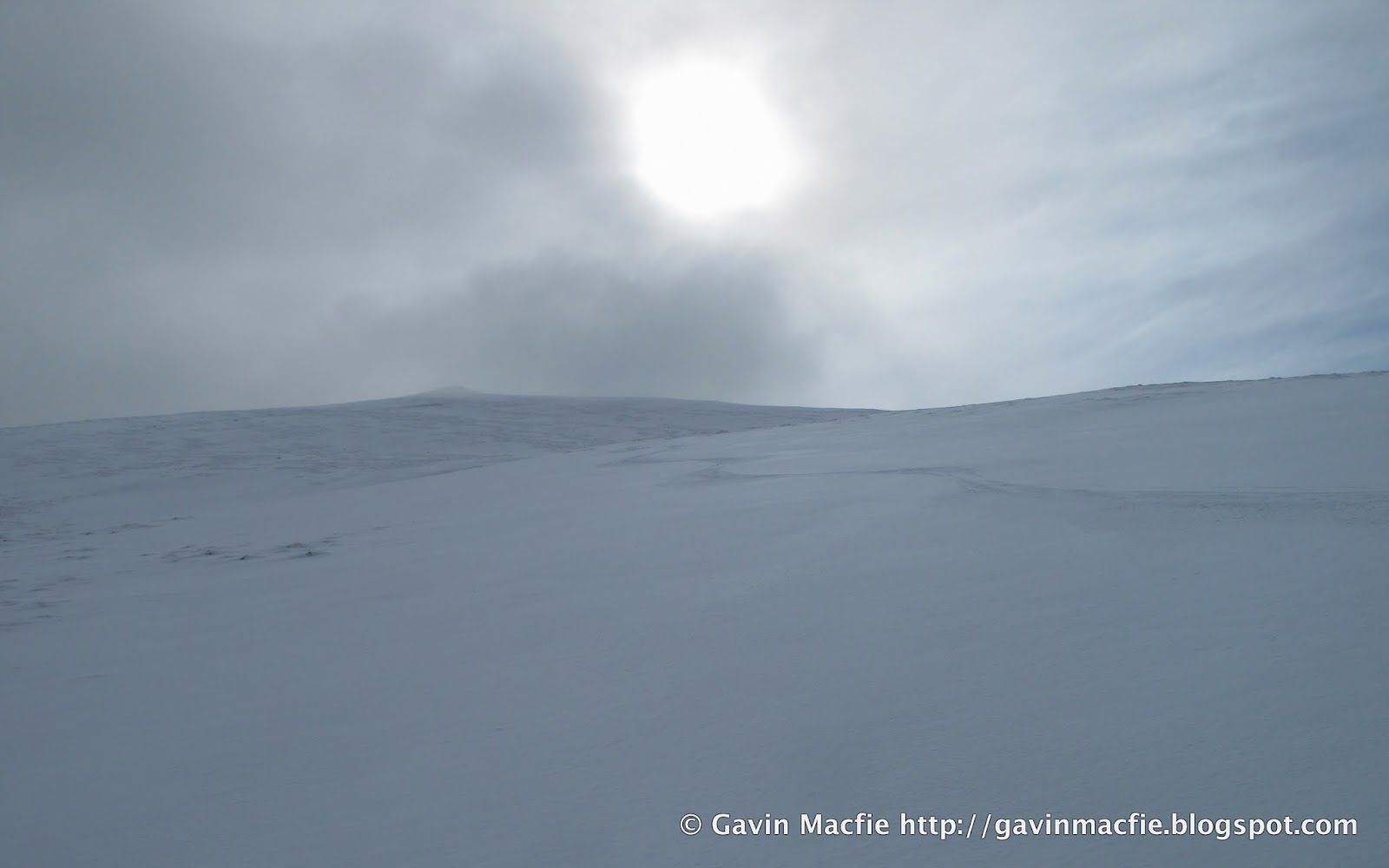
In the end it stayed clear for just long enough. After briefly savouring the summit views north to Fisherfield I enjoyed a fabulous ski descent, linking powder-filled depressions in the open slope. It was so good I decided to skin up and have another shot, but alas the first whisps of cloud were starting to curl over the summit and the visibility deteriorated steadily over the 30 minutes it took me to ascend. I lingered on the summit over lunch and coffee, hoping that the cloud would clear. Unfortunately it didn't and I descended haltingly in the flat light, delighted that I had managed that one superb run before the weather changed.

Skis off time

Labels: , ,

Thursday, 3 May 2012

Cairngorms: Overnight ski mountaineering trip


Coire an t-Sneachda

The fickle nature of Scottish winter conditions has been beautifully illustrated by this season. It got off to a promising start, but a thaw over Christmas took its toll and despite some further snowfall it all ground to a halt at the end of February, the earliest end to a season since lift-served snowsports began 50 years ago. I gave up and went skiing in France at the end of March. When I returned I waxed my skis and put them in the loft. That did the trick. The snows returned in late April, and they kept coming, allowing deep snow cover to build up over the Cairngorms. People always express surprise at April snowstorms, but they are are in fact a normal and reasonably predictable part of our weather, so much so that they have long been known in agricultural circles as 'lambing storms' for their propensity to appear, inconveniently, at the same time as the year's delicate crop of lambs.

What was unusual about this year's lambing storms is that they culminated in a week or near-constant snow over the tops before giving way to a weekend of sunshine. What's more this was not just any weekend, it was a weekend that had been reserved, months in advance, for outdoor sport. I had hoped that it might be spent be camping by a crag, climbing sun-kissed rock by day and drinking round the campfire by night, but this was not to be.

There could only be one choice of activity given the conditions, an overnight ski mountaineering trip taking in the big four tops of the Northern Cairngorms, Cairngorm itself, Ben Macdui, Carn Toul and Braeriach. I had first embarked on this route six years ago, almost to the day, when I'd only been skiing for a year. On that occasion  we decided to truncate our round by overnighting in the Garbh Coire Howff and accessing the Braeriach plateau via Garbh Coire Mor, missing out Carn Toul and Angel's Peak. Part of this decision had been driven by a reluctance to spend the night in the Corrour bothy, at the time notorious for overcrowding, mice and for being located in an area festooned with human excrement. All has changed since then, the bothy is now a cosy wee place, wood-lined with a stove and sleeping platform bunks. In order to address the jobby issue a composting toilet has been installed in a wooden outhouse. 

Pete, Stu and Colin on the steep section at the top of Allt Clach nan Taillear. Avalanche debris to the left.

After a couple of runs on the horrifically crowded piste we struck off from Cairngorm summit at at around 1300 hrs, bound for Ben Macdui. Reliable snow cover makes the jaunt to Macdui and back by far the most popular ski tour in Scotland, but it is most certainly not one of the best. The terrain is too flat, and flat terrain is the least enjoyable for touring on alpine kit. In truth lighter weight nordic gear is a far better choice for this particular tour, obviating the need to repeatedly affix and remove climbing skins. While such lightweight kit is advisable for the skier whose ambition is to bimble on the plateau, it is not the best choice for ski mountaineers seeking what the admittedly rather dated SMC guidebook describes as 'one of the finest and most challenging ski-runs in the Scottish mountains', the descent of the Tailor's burn (properly Allt Clach nan Tailler, the burn of the Tailor's Stone). My previous descent six years ago was a trying and exhausting one, the snow was heavy and the visibility was poor. This year it was revelatory, a pleasant glide on beautiful snow with the sun on our faces. I have been concentrating on improving my skiing this season and it had paid off, I'm now capable of enjoying skiing black with a pack.

Corrour Bothy and the Devil's Point

A light pack is critical for touring, but the activity itself requires so much equipment; shovel, avalanche probe and transceiver, skins and harscheisen, that I was unable to get the starting weight of my pack below 11.25 kg, including all overnight kit, food, camera and half a litre of water. Our packs were lighter back in 2006 because we didn't have any avalanche safety equipment, not that the spring conditions required them. This year, after a week of snow, it would have been rash to leave the safety gear in the car. In truth I am dubious of the benefits of transceivers in Scotland, having heard neither of anyone being saved due to having one nor of anyone perishing through the lack of one. For this trip I left crampons at home, unwilling to carry a kilo of ironmongery that wood almost certainly remain in my bag, reasoning that I could cut steps with an ice axe should I find myself on steep, icy, unskiable ground. I am glad that I didn't have to cut any steps and am now very tempted by lightweight crampons, the best of which are under 300 g. But perversely, investing in lightweight crampons would increase rather than decrease the weight of my pack, for I would actually carry them rather than leaving them at home.

The ice axes did come in handy at Corrour, where we found, to our surprise, a substantial log, over 2 m long and about 15 cm diameter. A previous visitor must have carried it in, hoping to find an axe or saw in the bothy with which to process it into stove sized lengths. We spent a at least an hour and possibly more taking turns at hacking away at the log, covering the surroundings in wood chips as if a group of beavers had picniced outside the bothy. There were three other residents who were, I think, rather bemused by the this prolonged bout of frenzied hacking. They seemed glad enough of the resulting fire though.

I was delighted to get a chance to inspect the famous Corrour toilet, an ingenious contraption that has two seats side by side. I didn't actually use the facilities, a surprising omission that I attribute to too consuming much oatmeal and not enough beer. At first it appears to have been designed with tandem crapping in mind. However on closer inspection it became clear that only one was in use. I recall reading somewhere that the toleys fall into a sack. Only once the sack is full and the hatch battened down to allow the composting process to take hold does the second seat come into play.

The day in prospect from the summit of the Devil's Point
The distant Southern Cairngorms, Carn a'Mhaim, Angel's Peak and Lochan Uaine from near the summit of Braeriach

It was wonderfully exhilarating to start another blue sky day out in the heart of the wilds of the Cairngorms.  I was outside with my porridge waiting for the sun's warmth to sweep down the flanks of the Devil's Point towards the bothy. I was the only member of the party who had any enthusiasm for starting the day with an ascent of the Devil's Point and so I strapped my skis to my pack and set off half an hour ahead of the rest of the party, ascending from the boreal spring into Scotland's island of Arctic tundra, the Cairngorm plateau. From the summit the day's sport was laid out before me; the peaks of Carn Toul, Angel's Peak and Braeriach are well defined and each provides a worthwhile ski run from its summit. The snow level was 700 m, reaching down to the high point of the Lairig Ghru. The transition between deep skiable snow and heather was a sharp one. The relatively high snowline accentuated the contrast between high and low ground, the col connecting Carn a'Mhaim and Macdui was highlighted beautifully. The distant peaks peaks of the northwest stood proud against the foreground of a practically snowless Monadhliath. The northerly Munros, Ben Mor Assynt  and Ben Klibreck,  were clearly visible, a full 80 miles to the North, as was the full length of the Caithness coast. Also clearly highlighted was the path of the Dee, the glen of which separates the northern and southern Cairngorms. 
Content after two runs of fresh tracks down Coire Gorm on the the best snow of the year
Approaching the teetering torture of the Chalamain Gap
There was a price to be paid for the wonderful descents from Sron na Lairig into Coire Gorm (it was so good we skinned up for another run), the walk out. We managed to ski to the lip of the Lairig Ghru but thereafter had to strap our skis to our packs, grit our teeth and dig deep for the descent into the gorge below, then the ascent to the torturous bouldery bed of the Chalamain Gap, a glacial meltwater channel carved in times past by vast volumes of melt water released by the Strathspey Glacier. We teetered our way through on empty legs to a soundtrack of plastic and buckles grating on granite.

Every single step required conscious effort. I constantly fought the urge to take off my pack and lie down on the ground during the toe mashing march below the Northern Coires to the Sugar Bowl car park where my van, comfortable shoes and orange and mango juice awaited. Above us the piste bashers groomed the slopes of the ski area ready for another day's skiing. The prospect was not appealing, it seemed more fitting to end the season with this unsurpassable phoenix of a trip.


Labels: , , , ,

Wednesday, 15 February 2012

Ben Wyvis Ski Tour

Ben Wyvis from the Culloden Battlefield
Ben Wyvis is prominent in the view northwards from Inverness, but it is nowhere near as close as it looks. Despite being over 30 miles away by road it is still the local Munro for residents of Inverness and one that I have been up on quite a few occasions.  The only time I have been up it on skis was over four years ago, in January 2008.


Motivation for winter sports can be hard to find when it feels like spring, as it did on Sunday morning, when I saw the view of Wyvis above while wandering round the Culloden Battlefield. It looked white, but I knew that the snow was a long way from the road. Conditions were therefore far from ideal for ski touring, but it is entirely possible that this damp squib of a winter is on its way out, meaning that this might be as good as it is going to get. I decided to embark on an afternoon skitour and on returning home I marshalled my equipment and set off.


I spent the entire journey on a motivational knife edge and almost turned back on several occasions, sceptical that there would be sufficient snow to justify the considerable effort involved in accessing it. When I arrived at Garbat the car park was full and the flanks of the hill were almost entirely devoid of snow.  I groaned inwardly at the prospect of having to explain myself and my peculiar choice of equipment to the steady stream of ramblers who were no doubt at present returning from the summit in the mild spring air.


 Less than ideal ski touring conditions on Ben Wyvis


Rather than carry skis up the steep slopes to An Cabhar I continued up the glen. That way if the snow cover was insufficient for a ski descent I would be spared the effort of lugging my skis up the steep path, actually more of a stone stairway in places.  It was a fine afternoon and I was delighted to be out. I have a new pair of ski boots that are a touch on the snug side   so I consoled myself with the thought that at the very least I would be wearing my boots in a bit and making them a bit more comfortable.


View from the Bealach Mor: Little Wyvis on the left and An Cabhar to the right. Still no snow....


Snow at last! This tongue continued to the summit with only a couple of short, heathery interludes.


Just above the bealach, after carrying my skis for about 4 miles, I found a sizable bank of snow. I affixed skins and struck up it,  even then thinking that if it ran out I would at least get a few turns on the way back down. But it didn't run out, rather it provided a semi continuous field of snow all the way to the summit of An Cabhar.  The dog rolled gleefully in the granular spring snow, his arthritis briefly forgotten.


Slightly murky on top, as is so often the case with Ben Wyvis.


The descent was an exhilarating blast on granular spring snow, with over 1000 ft of vertical.  Well worth the effort, in fact had I set out earlier I would definitely have skinned up and had another run. I think that, had I been accompanied by someone else with similar motivation levels, we would have either talked each other out of going in the first place or of continuing once we had started. Self deception can be a very useful skill.

For the record it took me 3 h 40 from car to car, including a picnic stop and would have probably been quicker had I taken the direct route of ascent.

Below are some photos of the slightly better conditions I experienced in January 2008.

Emerging from the woods at Garbat with a fine tour in prospect
Skinning up to the summit

On the summit of Wyvis, low cloud rolling in from the east.


Labels: ,

Friday, 2 April 2010

Road Rage in Glen Feshie

A top up of fresh snow meant that we had to dig our way into the car park at the Red Burn, much to the consternation of a couple of innocent motorists who were trapped in the midst of our skitouring convoy. One was on his way to work and the other felt that his 4WD car would succeed where one of our party's Subaru had failed. Nothing could be done to relieve their frustration until sufficient trenching had been done to shuffle the cars off the road into the freshly cleared car park. We must have made an absurb spectacle, stooping low as we dug feverishly using our short-handled snow shovels, like a troupe of dwarves.
Car to car skiing and cutting fresh tracks on Sgor Gaoith in the sun amply repaid our efforts. A great end to the winter? Maybe not, it's only Friday!

Labels: , ,

Tuesday, 16 February 2010

Informal snowholing and a new full length article in pdf


There's been a fair amount of chat this week about the banning of 'informal camping' on the east shore of Loch Lomond. This isn't a term I'd heard before and I suspect it has been coined recently to differentiate car-side, bevvy fuelled,  litter producing camping from the more honourable pedestrian based, zero impact ideal of 'wild camping' that is permitted under the access legislation.

A trip to Cairngorm at the weekend revealed that 'informal snowholing' is a possibility at present! The slopes immediately to the south of the Ciste car park have a two rows of commodious looking snowholes dug into them. If the urge took you you could simply park up and sneak inside for a night's kip.

This discovery inspired me to add a new article to the site, documenting a less than entirely restful night spent stormbound in a snowhole, high on the Cairngorm plateau. Click on the link to the right to access a pdf file containing 'A room without a view: snowholing in the Cairngorms'.

Labels: , , , ,

Tuesday, 12 January 2010

A tale of two visits to Creag Meagaidh

Creag Meagaidh occupies a central position in Scotland both geographically and in terms of mountain sports.  Its cliffs, the view of which unfolds throughout the approach to Coire Ardair like the plot of a good novel, are rivaled in scale only by the likes of Ben Nevis and Ben Lair.  Walking the last few km into the coire is like entering a magical kingdom, like stepping into legend.


The cliffs of Coire Ardair from Lochan a'Choire, April 2006

On my first visit this impression was enhanced by the discovery of a snow dwelling - a tent within a snow wall, - like some kind of wintery Masai boma. We did not engage with the inhabitants, our eyes instead drawn skyward. We'd come to attempt the 1957 Face Route, originally climbed by a team including Chris Bonington and Dougal Haston. The route seemed a sensible choice in the prevailing snow conditions - lots of it and a thought provoking avalanche forecast. The route extends almost to the coire floor, leaving only a short snow slope to negotiate. As we surveyed the face I became uneasy about an apparently unavoidable and heavily loaded snow slope high on the route. My partner, who was more experienced than I, was less concerned. He was confident that we would surmount it somehow and his enthusiasm carried us up to take a soggy, dripping belay at the base of the route. After a bit of exploratory poking we pronounced the route out of condition and the game a bogey. We retreated to the car park with our tails between our legs, lamenting the amount of effort required to participate in our chosen sport.

Sitting in the boot of his estate car was a ski tourer, his tanned face justifiably smug at having successfully executed his day's sporting plans on the ridges while we were groveling our way to failure in the chilly shade of the coire. The wisdom of skiing in preference to climbing under such snow conditions began to dawn on me and the ambition to undertake a ski mountaineering ascent of Creag Meagaidh started to take root in my imagination.

That ambition was realised on Sunday. Rushes of euphoria tingled at my temples as I skinned along the ridge towards the summit plateau under blue skies, a hard-earned natural high that will stay with me forever. Row upon row of snow peaks lay ahead, but my eye was drawn irresistibly to the cliffs of Coire Ardair. I no longer feel the same hunger to test myself on the classic climbs that grace their faces, yet I know that a combination of perfect conditions and a suitably motivated partner could easily see me fall under their spell once again. My pulse quickens at the thought.


View from Carn Liath summit towards Coire Ardair and Coire a'Chriochairean, January 2009. This is the same shot as featured in my previous post, hopefully less grainy this time.

The arctic wastes of the Monadhliath stretched away to my right, a blanket of white broken only by the  vulgar dark green of the conifer plantations that lie to either side of Melgarve bothy and the line of pylons – soon to be super pylons - that march from its doorway over the Corrieyairak Pass towards the Great Glen.

Revisiting a place like Creag Meagaidh provides an opportunity to see clearly the person that I was on my previous visit. The gradual changes that have occurred, almost imperceptibly, over the intervening years are brought into sharp focus by the relative timelessness of the landscape. Such changes are practically invisible from the comfortable vantage point of our day to day routines.Wild places provide the punctuation we need to make sense of our stories. This visit highlighted how my motivations have evolved over the last few years. I wonder what insights my next visit will provide?

Creag Meagaidh has been managed as a National Nature Reserve since it was was purchased by SNH in 1985. I've been mulling over issues of land management, re-wilding and species introduction and will discuss them in next week's post.

Labels: , ,

Sunday, 10 January 2010

Creag Meagaidh Skitour: traverse from Aberarder to Moy

What a tremendous sunny Sunday. We tackled one of Scotland's 4 star classic skitours, the traverse of Creag Meagaigh from Aberarder to Moy, taking in the summits of three Munros. We had the route to ourselves,  fresh tracks all the way. The snow on the descents was some of the best I have experienced in Scotland.

This is as good as it gets, the stuff that dreams are made of. I'll let the pictures speak for themselves.


The day in prospect, viewed from the slopes of Carn Liath. The prominent notch in the centre is the Window, the cliffs of the upper coire of Coire Ardair can be seen to the left of the Window; Coire a'Chriochairean is the right; Creag Meagaidh summit plateau to the far left. The regular approach to Coire Ardair goes up the glen, past birch-covered hummocky moraines.


View from Carn Liath summit towards Coire Ardair and Coire a'Chriochairean. A bitterly cold easterly wind swept a carpet of spindrift across the summit.


Waves of euphoria engulfed me as I skinned along the ridge towards Coire a'Chriochairean.


The high plateau of Creag Meagaidh on the right. We deviated slightly from the guidebook route to avoid suspect slopes in the vicinity of the Window.


Excellent snow on the descent from Creag Meagaidh summit towards the Moy Burn.

This tour could well turn out to be the highlight of the winter. It should certainly be enough to put paid to any feelings of angst at not having capitalised fully on this cold spell. Having said that I do quite fancy climbing some ice........

Labels: ,

Tuesday, 29 December 2009

Fionn Bheinn Skitour (Achnasheen)

Still very cold; skitouring conditions are excellent but motoring is sometimes challenging. The remote control for unlocking my car met a soggy end some years ago, forcing me to open it with a key like everyone used to in the old days. This old-fashioned ritual becomes problematic when all the locks are choked with ice. Last week at Cairngorm I was fortunate enough to have some warm dregs in my flask which I used to free up the lock. When I got back to the car after a thirsty Sunday morning skitour my flask was empty but with a little cunning I was still able to use its contents to open the door!

Fionn Bheinn is an outlier of the Fannichs whose peathagged slopes rise above Achnasheen. It's not the most inspring hill I have ever climbed but it is both a short ascent and very accessible, being within an hour's drive of Inverness  This makes it a great choice for around the solstices; either as a quick hit on a summer's evening after work or, as I experienced it on the 27th, an excellent skitour for the short days of midwinter. It is at its best when the peat hags that scar its slopes are filled with snow, but its isolated position makes it a fine viewpoint at any time of year.


Slioch from the summit of Fionn Bheinn.


The ridge of Liathach caught  the early morning sun as I ascended Fionn Bheinn. Beinn Eighe is to the right

View towards Slioch from Fionn Bheinn

Labels: ,

Saturday, 19 September 2009

Ski touring in the Swiss Alps: Bernese Oberland via the Jungfraujoch

The ski mountaineering playground of the Bernese Oberland is hidden from the alpine ski resort of Kleine Scheidegg by the forbidding ramparts of the Eiger, Moench and Jungfrau. The buildings of the Jungfraujoch – Europe's highest railway station - nestle like turrets or battlements on the ridge that connects the Jungfrau to the Moench. They provide a halfway house between the familiar world of buildings and trees and the unseen realm of the Oberland, with its glaciers and kilometre thick ice, an echo of the Karakoram lurking in the middle of Europe, like a stowaway in a ship’s hold.


The Jungfraujoch is visible in the col between the Moench and the Jungfrau. Kleine Scheidegg is in the foreground, just right of centre. The Eiger is out of shot to the left.

As we awaited the Jungfraubahn at Kleine Sheidigg, the sun popped into view, perfectly and centrally located in the col between the Eiger and the Moench. All that had been shaded was now bathed in light. As the sun's rays caressed my face I felt that our timing was auspicious, astronomically perfect, as if we had arrived just in time to catch the light of the solstice illuminating the back wall of a neolithic tomb.


The Jungfraubahn (Eiger railway) with the hotel at Kleine Scheidegg and the Eiger in the background. the train goes through the north face of the Eiger, stopping at windowed galleries en route.

The impeccably situated Konkordia Hut overlooks the Korkordiaplatz, a vast desert of snow-covered glacial ice, radiating legs like a starfish up into the flanks of the surrounding 4000ers. The hut was built perched on a ledge, 70 m above above the kilometre thick ice of the glacier. Now the ice has thinned, increasing the climb to the hut to 120 m. Access up the sheer rock face is provided by a disconcerting metal stairway, of the type found snaking their way up the sides of chemical plants. The only concession made by the ladder builders was the provision of a single banister, always on the outside. Between the inside edge of the stairs and the rock face yawned a disquieting gap.


The Konkordia hut is to the right of this photo, above and to the left of the obvious gully that splits the lower face. The infamous hut ladders can be seen zig-zagging up the face to the left of the gully

A shadow danced before us on the snow. Looking up I saw a butterfly flutter overhead, carried from another place and another season, a rare meeting with a fellow life form in these practically deserted hills. What fate for the insect up here in this land of ice and rock? Perhaps it would it traverse the Oberland faster than us, the wind carrying it from winter back into spring. A trio of choughs greeted us like ravens on the summit of Wysnollen; had the butterfly succeeded in running the gauntlet of their yellow beaks?


On the summit of Wysnollen

Euphoria engulfed me as I skinned up the Konkordiaplatz. Teams ahead were swallowed by the white desert, dwarfed. The North wind carried a carpet of spindrift across my path. Occasionally a lone spiral pirouetted in front of me. Ten thousand years ago the great Moor of Rannoch may have looked similar to this. If the Konkordiaplatz were to turn to lochan-studded moorland, what would the rest of the world look like? Clouds began to form; a dark shadow below the glacier tricked me into seeing a lochan, into glimpsing the future?
 

Skinning up towards the Hollandia hut and the long descent to Blatten beyond


This trip took place in the winter of 2009 (March 16th – 20th).

Labels: , , ,

Monday, 17 August 2009

A local skitour for local people

The middle of August marks a turning point in the year: the days become shorter; the ending of the school holidays congests the roads; people resume their constant droning about football after the summer ceasefire. About this time my mind begins to wander towards the coming winter and the sporting opportunities it may present.
Last winter I enjoyed a truly local adventure, a circular skitour beginning and ending at my front door, taking in the great area of moorland bounded by the River Nairn to the north, the Findhorn to the south, and the A9 to the west.
In the comfort of my living room I tightened my ski boots, shouldered my pack, then cast my skis out the front door onto the garden path. The time was just before eight and the streetlights still glowed orange. My skis slid easily on the fresh snow. I crossed the main road to gain access to the expanse of fields leading down to the sheer sandstone arches of the Nairn viaduct. The orange walls stood out thanks to their steepness, shedding the snow rather than allowing it to accumulate. The river was a ribbon of black, chugging slowly beneath the snow arched branches of the alders, its edges blurred and squeezed by sponges of slush, slow to melt in the chilly water, the current close to the banks insufficiently strong to sweep them seaward.
Past Clava House I cut over a field, once again in the shadow of the great arches of the viaduct. Casting my eyes backwards I was delighted by the twin trenches snaking behind me. The low sun lent them depth, the only features in this carpet of white. I affixed my climbing skins and set off up through the larchwoods. The woods were still and calm, a great silence having descended along with the snow. Animal tracks became commonplace, birds, roe deer and hares. The fine powder had the appearance of having been dusted straight from the sky, like icing sugar onto a mince pie, but here among the tall trunks of the larch the half-coated trunks revealed the direction from which it had come. The mass of accumulated snow had caused several boughs to shear from their parent trees onto the track. I negotiated my way round them, eager to escape the confines of the forest and break out onto the wide open moorland beyond.

Pylons carried crackling power cables above my head as I struck out onto ever deepening snow. The full extent of the snow cover became apparent, in front of me stretched a panorama of white, Saddle Hill to the left, Beinn Bhuidhe Beag and the distant heights of Beinn Bhuidhe Mor in front.
Huge erratic boulders are much in evidence in the straths, but are conspicuous by their absence here on the moor. Save for the small granite crags that cap the southern flanks of Saddle Hill, these hills are primarily composed of sandy gravel, the plateau having presumably been beyond the reach of the great glaciers that flowed from the coires of the Monadhliath down the straths during the last ice age. A few wizened Scots pines grace the steep banks of the burns which radiate out like the spokes of a wheel. Recent, sympathetic, planting of young trees mean that in future a small revival of Caledonian forest will be nurtured on these slopes. Twisted remnants of bogwood hint at what may be their eventual fate. I admired the panorama that presented itself across the deep blue waters of the firth to the north: the great hulk of Ben Wyvis and the jumble of the Fannichs rising beyond the Kessock Bridge; the pointy peaks of the Strathconon Corbetts; the long, triple-summitted ridge of Beinn a' Bha'ach Ard that guards the entrance to the long lonely reaches of Strathfarrar; a glimpse of one of the Affric hills peeping above the Scandanavian forests of Abriachan.
While these distant peaks drew the eye, it was the rounded hills to the south, the ones that were actually within striking distance, that captured my imagination. The snow had been settled slightly by the wind and my skis sank less deeply into it. I eyed what I now suspected to be tremendous fields of firm packed snow extending into the wild, committing terrain to the southeast of Beinn Bhuidhe Mor, the high plateau beyond Carn Dubh Mor containing the Graham, Carn nan Tri-tighearnan. As it had taken me well over two hours to make it this far, such an itinerary would have to wait for another day, perhaps on lightweight Nordic touring kit.
The city of Inverness and the jumble of houses at Culloden Moor were still in view. In the still conditions I could hear a plane taxiing at the airport. So close to civilisation and yet, up here on the snowfields, in a different world.
I crossed the tracks of a fox, laid out in a straight line as if the animal was walking a tightrope. Periodically he had paused to excavate small holes, perhaps hunting for mice below the snow in the same way that a polar bear would for seals below the ice. Grouse appeared as black sentries silhouetted against the snow. They strutted indecisively backwards and forwards, both feet and wingtips tracing their progress on the white canvas.
A sandwich and the dregs of my flask sustained me on Beinn Bhuidhe Beag's 460 m summit as I rested my legs in preparation for the descent down its steep northern flanks. There was a boundary fence to negotiate but the snowcover was sufficiently deep that I was able to slide over the top wire without stopping. Deep powder awaited and inspired me on this delightful but all too short descent. Euphoric, I reaffixed my climbing skins in the depths of this normally boggy hollow and decided to pick my way up through the dwarf pines onto the west ridge of Saddle Hill. The sinking sun coloured the sky a deep azure as I made my way across the flat fields to home. My legs were weary after seven hours on ski but my heart was light, an ambition had been achieved. I had seized what, in the uncertain and changing climate of the future, may turn out to have been a once in a lifetime opportunity.
We live in an age of lists. Our shops are full of coffee table books of one hundred things to do before we turn thirty, or before we die. All too often these are commercially based activities in far flung countries: jet boats and bungee jumps in New Zealand; hot air balloon rides over the Serengeti at dawn; rafting the Zambesi. Our worship of these exotic dreams implicitly devalues those which are more local or commonplace. In truth the ordinary may be extraordinary, and if we search deeply enough each one of us will find our own dreams lurking. Many of them will be local, attainable, affordable and doubly satisfying because of the creative spark needed to visualise them in the first place.


Labels: , ,

<data:blog.pageTitle/>

This Page

has moved to a new address:

http://livingmountain.net

Sorry for the inconvenience…

Redirection provided by Blogger to WordPress Migration Service