Wednesday, 5 October 2011

Urban exploration in New York

When this guy realised I was from Scotland he started singing the praises of George Galloway, who is now something of a celebrity in the US 

Last week I had the opportunity to travel to the US with work.  My itinerary took me to New Jersey, just outside the great city of New York. This was my first trip to the east coast.  While off duty I sought opportunities to interview the Americans whose paths I crossed, hence this week's post will be the first example of straight travel writing that this blog has seen for a while.


When the president of the US publicly states that the rich should pay more tax than the poor it can mean one of two things. Either we are poised on the cusp of great change, or Obama's days are numbered. Indeed both may be true. In any case it is unprecedented, particularly when on our side of the Atlantic Cameron and Osborne are taking the opposite position, keen to scrap the 50 p top rate of tax. Hundreds of protesters are occupying Wall Street, demanding that the rights of the many take precedence over those of business and the very wealthy. Now these ideas are out they will be difficult to contain. If the much feared double-dip recession materialises, I would not be surprised to see civil unrest. All in all these are interesting times.

Some people love to travel on business. I'm not one of them. Living in hotels makes me feel a bit like Alan Partridge and I generally find the experience at least mildly disagreeable. You may ask yourself what is so disagreeable about staying in fancy hotels and eating out on expenses. Well for a start there are the hotels themselves. The hotel I visited on my arrival in the Philadelphia area was a classic of the genre. On walking through the doors I felt immediately oppressed by my surroundings. The high ceilinged lobby was decorated with murals of paintings of hunting and agricultural scenes. A discordant muzak, slightly too loud, lent an edge of menace, jangling my nerves. From behind the doors of the Fox and Hounds Pub (advertised as 'genial' on a poster in the lift) came a most unfamiliar noise, the nasal braying of corporate Americans, loaded on alcohol after a meeting or conference of some sort. 

You don't see wallpaper like that every day. Unless you live in a hotel.
 My room was located down a seemingly endless corridor with wallpaper so vile I photographed it. Even in my drowsy state I knew that I would never be able to recall it in its true, horrifying detail. The bed was a four poster, overfilling the room. I groped for light switches, eventually realised that I had to reach inside the shades of half a dozen lamps in order to locate fiddly, rotating switches. Eventually the room was bathed in sufficient light for me to establish that there was no minibar. There was nothing for it but to brave the wallpaper and head downstairs to the bar. The noise was such that I expected to find the place packed but there were only around ten people, all roaring at one another across the tables t the tops of their voices. I caught snippets.

"...up by 25 %, broke all records again this year."

"This account is gonna explode."

"Those guys love Larry, they love him!"

I soon managed to filter it out, quickly drank a Sierra Nevada Pale Ale, then retired for a restless night, wrapped against the chill of the aircon while outside the cicadas' chorus filled the sultry night air.

After a day's work I travelled north to New Jersey. My driver was a London-born Arab who celebrated his roots through the consumption of Walkers ginger biscuits and Cadbury's Dairy Milk. We crawled through rain and dense traffic, through unremittingly built-up but leafy country.  He told me his story, how he had three daughters and a Mercedes that he couldn't really afford but couldn't bring himself to release, so loaded was it with boyhood memories of his father's Merc. He had relocated from New Jersey to Pennsylvania to improve his children's schooling, but the pharmacy in which he worked had renaged on their promise to transfer his role. After fifteen years they asked him to start at the bottom, forcing him to quit and leaving him without redundancy or welfare entitlement. He was philosophical, reasoning that plenty people were worse off than him. My driver earlier in the day had touched upon similar themes.  Since the downturn he had reined in his spending and had found the experience revelationary. Both resented the eastwards shift in the balance of world power, of jobs and manufacturing, to China. Perhaps it was all part of their pitch for a tip.

My next hotel was reassuringly bland, with accessible light switches and none of the distinctive but disconcerting touches of my previous lodgings. It amused me that the room contained a catalogue through which all the furnishings of the room were offered for sale, allowing those so inclined to furnish their homes like a Marriot hotel. I read in the guest information that a map of a jogging route was available from the front desk. The description was very American, clearly setting out the conditions of use and guarding against litigation. The menu on the TV contained a similar warning prior to the adult film selection, cautioning the viewer that the acts depicted were not necessarily safe and that the hotel was not in any way responsible for any injuries sustained while trying to emulate them.

'This course has proved to be a favourite of past guests. Although we provide a map for your convenience, we assume no responsibility for injury or damage which may occur while using this route.' 

The rain had stopped and I was in the mood for exercise so I decided to head out. The desk guy advised that I run part of the route then retrace my steps but I set out intending to complete the route. Where possible I ran on the thick, leafy grass that adjoined the pavement, sweating in the humid air. I passed floodlit softball diamonds where teenage girls were practicing. The thump of the ball in the catcher's mitt took me back to my childhood, when I had played Little League baseball with the Bute Buccaneers. We travelled to the nearby US naval base in Dunoon to play with the offspring of the servicemen. The base had a Baskin Robbins ice cream shop where we paid in pounds and got change in cents. This was back in the 1980s when such delights were unknown in the UK. There was always vomiting on the return journey. My baseball career was short-lived. The first year we were beaten in every game. The second we practised hard and won the league. We weren't invited back to defend our title.

The route became harder to run, with the pavement petering out unexpectedly. It became unclear what was verge and what was unfenced garden. The wooden houses felt sinister, set back from the road amid trees. Streetlighting was minimal or non-existant. I was forced to run on the shoulder, nervously eyeing the oncoming traffic. I had read of joggers and cyclists being harassed and even assaulted - pushed over or scalded with hot coffee - by suspicious, uncomprehending motorists. Upon reaching the suggested turnaround point I was confronted by a pavementless, unlit road. I heeded the desk guy's advice and turned round, glad to have explored my surroundings. If that route was a favourite I wouldn't bother to try any other. I can only assume that the past guests for which it had proved a favourite weren't quite right in the head.

Many of the people I spoke to drew my attention to the difference between the laid-back west coast and the stressed, joyless east. People in California look after themselves, eat well and exercise regularly, they told me. Not so in the east where everyone wears dark clothes and splits their time between working themselves into the ground and being pre-occupied with traffic. A ninety minute commute is standard and the New Jersey drivers are reputed to be among the worst in the US. 

I was amused by how unaware the typical American is of the extent to which their culture dominates the rest of the English-speaking world. One guy who lived in Philadelphia drove past the Rocky Steps on his way to work each day. He checked that I was aware of the Rocky movies before telling me that any time of the day or night you can guarantee that someone will be running up those steps, acting out the scene from the film. It is little wonder that Americans find so little time to travel, it being pretty standard to have only ten days leave and five public holidays for the first few years of employment. Their allocation only rises to twenty days total after five years of service. An Indian guy I met in a bar joked that lack of time off is never really an issue because they get fired so frequently that they can always count on some time off between jobs.

After my work obligations were over I had some free time to head into the Big Apple. The cab driver that took me to the train station was a fat barrel of a man. Not fat in the wobbly way, he looked pneumatic, as if he had just been freshly inflated with a bicycle pump.   We were driving down a street in which a large proportion of the houses had flags mounted on the front. It was raining heavily and the flags hung limp. I mentioned them to the driver and set him off on a rich rant.

“Fucking Americans.” He noticed that I was looking at him oddly and clarified, “I’m Irish.”

He gestured to a house with a flag. “White trash. In Europe you would call these people Nazis.”

He spoke positively about life in the US, claiming that he and his wife received free healthcare and three thousand dollars state pension per month.

“You get state welfare and local welfare too. Nobody tells you that shit, they think we’re all dying on the streets. It’s not like that at all.”

His mention of welfare reminded him of the Republican Presidential hopeful Rick Perry and his comments about welfare.  “Rick Perry said that welfare is a Ponzi scheme. It’s not a Ponzi scheme – that’s a criminal activity. Man’s a fucking lunatic. Michelle Bachmann said that the hurricane and the earthquake were God’s punishment for spending too much on welfare. They’re all fucking lunatics.”

I asked if he thought the new Tea Party brand of Republican was worse than George W Bush. He felt that Bush was so near the bottom of the barrel he would be hard to surpass. We marveled at how poor people on both sides of the Atlantic continue to vote for parties that will only ever look after the interests of the very wealthy. The cabbie summed it up elegantly, his wise words rang in my ear as I shouldered my bag and walked into the train station.

“People are fucking stupid, they’ll always be fucking stupid. Ain’t nothing anyone can do about that.”

I changed trains at Newark and the final approach into New York reminded me of taking the train from Weymss Bay to Glasgow Central in the height of the early 1990s gloom: vacant yards; derelict red brock warehouses; industrial wasteland interspersed with the river and its reed beds.

The weather had been unusually wet in the east while drought hit the west. The drought meant a lack of food for bears and there had been a number of attacks in recent weeks as hungry bears sought food in populated areas. Upon exiting Penn Station I found pouring rain, a real monsoon downpour, the likes of which is rarely seen in Scotland. Umbrella salesmen touted their wares. Their time had come, up to four inches of rain were forecast over the weekend.

“Buy an umbrella, stay dry!”

I suddenly remembered a story about someone taking advantage of a downpour to offload a dodgy batch of umbrellas with runny black dye that left the unsuspecting customers looking like wet coal miners.  Anyhow I wasn’t convinced that an umbrella would do much good with the rain bouncing off the pavement. Everyone else had one and once the water started to run down the inside of the arm of my Paramo jacket I began to question the wisdom of my decision. I certainly wasn’t going to buy an umbrella after I was soaked.

An open topped sightseeing bus drove past. At the corners of the top deck were holes designed to let water drain out. It was as if a fireman’s hose had been pointed out each one. The top of the Empire State building was in cloud. I made for Times Square in the hope of finding a suitable window through which to watch the rain and the wet people. Blue Fin, a sushi bar, provided just such a window. Outside I saw a parade of improvised raingear. Umbrellas of all sizes. Ponchos, clear, blue, pink and camouflaged queued for tickets to Broadway shows. Each group of tourists had purchased simultaneously so they looked like teams in uniform. Bedraggled toddlers were pushed past, swaddled in polythene. Despite the rain it was very warm, indeed the impression was tropical, accentuated by a tented village in which an Asian cooking festival was taking place.  Live footage of the cooking was beamed onto huge plasma screens. The stallholders used sticks to drain the accumulated water from the roofs of their tents. This combination of ponchos and sizzling woks brought to mind a tropical downpour I experienced many years ago in Bangkok. For a moment I was caught in a reverie, looking back into the mind of the person that occupied my body thirteen years previously.

Times Square 
Times Square is an appalling and engrossing magnet for humanity, people are drawn there from all over the world. Some are there to see Broadway shows, others, myself included, were there only to see the others. Such an accumulation of life is a spectacle in itself, like the zebra herds in the Masai Mara, like the elver migration in the Sandaig burn, so elegantly captured by Gavin Maxwell, whose biography had filled my empty evenings in faceless hotels. On the plasma screen the chicken was drained from the wok. Surrounding them was a sea of flashing neon Americana; the golden arches, TGI Friday, the Roxy Deli, movie and show billboards. Above the buildings reached higher than I could see. If the fauna of Times Square was engrossing so was the landscape. If the skyscrapers were rock towers they would be genuinely awesome. 


It was still raining and I knew I hadn’t the heart to trudge round Central Park, or to take the subway down to the recently opened memorial at Ground Zero. In any case I had only a couple of hours until my train. Near Penn Station I found a marvelously shabby Irish bar called Blaggards. Some of the letters had fallen off the name and the toilets were in a terrible state of repair. I took a seat at the long bar and ordered a pale ale. A gigantic man with a red and white pinstriped shirt and matching bow tie took the seat beside me. He twisted his waxed moustache as he ordered a beer. He revealed himself to be a banker. Commercial lending, he hadn't touched any sub-prime mortgages. As the plasma screen in the bar dispensed financial tips explaining how to make money in a falling market the banker told me that he was only a year from retirement and had cashed in all his investments, fully expecting that we would be in full-blown recession a year from now.

The owner of the bar was, unusually for an Irish bar, actually Irish with a broad Dublin accent undiluted by 20 years in the US. I only just managed to decline his offer of a fourth beer before he started pouring it and made my way into Penn Station, aiming to catch the 1809 Dover train. Due to the rain the trains were delayed and I found myself packed into a humid subterranean holding chamber along with hundreds of other commuters. We watched the screen as train after train went from ‘On Time’ to ‘Delayed’. Some went all the way to ‘Cancelled’. I struck up a conversation with a trio of Indians from Chennai and a bespectacled, sallow-faced youth who stood beside me. 


Our banter was interrupted by a loud altercation between a tall, bearded thug of a man in his twenties and a middle-aged Asian. The thug had knocked the Asian as he barged through the densely packed crowd. Afterwards he turned and, instead of apologizing, shouted a torrent of abuse and then stared menacingly, at the poor man, who, clearly mortified that several hundred people were witnessing his silent face-off with the thug, stared at his shoes, hoping the floor would swallow him up. The thug moved on and a babble of chatter filled the silence. I was delighted, for angry people shouting at one another in the street was a New York stereotype that I had been hoping to encounter. It could only have been improved if one of the participants had been carrying groceries home from the deli in a handle-less paper bag which had split open during the collision. Or if one of them had pulled a gun.


A train arrived and part of the crowd, including the Indians, exited left. They were immediately replaced. I interrogated the sallow-faced youth; after a few beers I fancied myself as something of a Louis Theroux. He was a film student who wanted to direct horror films. He had spent the day doing unpaid work at his church, which owned video equipment that he hoped to make use of in future. He was dismayed that they had made him spend the whole day coiling cables then testing their integrity. His church was St Andrew’s but he was unaware that Andrew was the patron saint of Scotland. I tried in vain to recall what connected this middle eastern apostle to my homeland. Clearly something of an innovator, Andrew had eschewed the standard cross and insisted on being crucified on an X shaped cross.  At some point after this I believe his remains were transported to Scotland and the shape of his cross was incorporated in the national flag.

On the train I sat beside an attractive female student who unsettled me slightly by taking a well-thumbed illustrated bible from her bag and starting to read. On questioning she revealed that she was studying business and theology at a catholic college. She wasn’t religious herself, but she tolerated the theology which was compulsory. Her only interest was in the business part of the course, which she saw as a passport to travel in Europe after graduation. She clearly didn’t want to talk to me and soon managed to get her headphones on.

When I was younger and more naive I made the mistake of thinking that the bond of a common language meant that the UK was more closely aligned with the US than with Europe. I realise now that our values are European, and nothing makes me feel more European than a trip to the US.  It was a relief to get down from the train and retreat into a Scottish enclave, where I spent the rest of the evening and the next day catching up with friends who now live in the US. It is invariably a great pleasure to meet up after a lengthy separation, especially when you find friends apparently unchanged by the passing of a decade. 

Groundhog (or woodchuck) on the golf course. 

Labels: , ,

Monday, 17 January 2011

A Photo in the Hand is worth a thousand in the Hard Drive

I have recently rediscovered the joy of the printed photo; the excitement of returning home to find a pack of prints on the doormat. It's just like the old days before digital photography, but with one important difference. Each image is a perfectly crafted work of art; carefully selected from among dozens of its peers; lovingly straightened, cropped and tuned. The end result is infinitely more satisfying than an image on a screen could ever be.

The Devil's Garden, Arches NP, Utah, April 2010. Of the thousands of pictures I took over three weeks in Utah this is my favourite. The essence of desert is here, its beauty lying in the sparsity of the vegetation, each plant and each rock perfectly placed, as in a zen garden.
I was awed by the vivid red rocks of the Colorado Plateau, but the Americans I spoke to invariably mentioned the otherworldly greenness of Scotland, which they cited as one of the main reasons that they wanted to visit. There isn't much green in this view of the snow peaks of the Arrochar Alps,  taken from the shore of a frozen Loch Fyne on January 7th.

Labels: , , ,

Monday, 3 May 2010

Back to reality: from one outdoor paradise to another


During my visit to the Grand Canyon I was reading John Wesley Powell's account of the original exploration in 1869 (I think). In his summing up he suggested that, should one be desirous of a full appreciation of the vastness of the canyon and of the variety of its landscapes, it would be necessary to spend an entire year within its confines. Accordingly I'm not going to bother describing my superficial brush with the Grand Canyon's South Rim. Suffice to say I will be back. The idea of a rafting trip or a through hike from rim to rim is very appealing.

Not being a believer in the phenomenon of jet lag I found the invitation to join an overnight skitouring trip in the Cairngorms that greeted my arrival to be irresistible. Less than 24 hrs after arriving home I looked out my National Park pass and drove down to the Park Headquarters to see if they had any wilderness permits remaining for the Coire Cas trailhead. We hoped to reserve one of the highly prized backcountry campsites in the Loch A'an Basin, but what were our chances on a Bank Holiday weekend?

What relief I felt when I remembered that we do things differently in Scotland. Our access legislation means that there is no requirement for a Park Pass; no need to obtain a Wilderness Permit; no need to book a campsite or even decide in advance where we would stop for the night.

This will seem strange to any North American readers, but we simply parked our cars and wandered off into the wilds of the National Park without processing any paperwork or paying any fees.

Upon arrival I found that the rest of the party had decided to accommodate themselves in a 3 man tent. With characteristic generosity Mearnsey offered to share a second tent with me; the only slight snag being that due to his already overflowing bag I would have to carry the whole thing myself. I declined his offer, gambling that the weather would be suitable for simply dossing down in the open.

And what a fine bivvy it proved to be, I excavated a depression on a relatively flat snow patch beneath the Shelter Stone. The howff below the stone itself was as commodious as I recall from the last time I overnighted there but some residual snow inside, the melting of which had resulted in muddying of the floor. This made a bed of clean snow in the open air a far more appealing prospect.

And the consequence of the permit free access to the Loch A'an Basin? Far from being overrun we saw the torches of only two other parties shining among the moraines and boulder-fields.
In Powell's book he discusses the indigenous inhabitants of the Southwest. In keeping with the language of the time he describes them as savages, but he does concede that some had almost effected the transition from savagery from barbarism.

Come morning Neil was kind enough to use his shiny new avalanche probe to transfer a bacon roll from the tent to my nearby bivvy. I felt like a hungry savage receiving a handout from benevolent barbarian neighbours.

Labels: , , , ,

Wednesday, 28 April 2010

Final leg of the Grand Circle tour

From Moab we travelled south, making good time. This tempted us into detouring to Hovenweep National Monument, home to some ancestral Puebloan ruins. Ancestral Puebloan being the politically correct version of Anasazi, a word that some found offensive because due to its origin as a Navajo word meaning 'ancestors of the aliens', the Navajo having settled the area in the late 1500s, long after the zenith of the ancestral Puebloan society and the building of the now-ruined buildings.
The short walk round the canyon upon which the ruins are perched was extremely mellow, as was the nearby campsite. An unexpected gem and a complete contrast to the high octane atmosphere of Moab.
The original plan had been to camp in further down the road in Monument Valley and I'm glad we didn't. Not that Monument Valley wasn't spectacular; its red sandstone towers are a sight to behold. We've all seen it before though, in books and on TV, and there isn't much more to it than can be conveyed through a photo. It is also very much the tourist trap with a hotel and gift shop complex built on a low ridge to act as a barricade, hiding the classic view until the appropriate admission charge has been paid to the Navajo owners.
Genuinely spectacular was our next stop, the Navajo National Monument, a large collection of ancestral Puebloan cliff dwellings dating from the same period as Hovenweep, the 1200s. Amusingly enough we saw a couple pushing a small dog in a specifically designed canine pushchair.
In the course of visiting these Puebloan sites I've had a misconception corrected. I'd been under the impression that North America was settled comparatively recently, but it was actually at least 11,500 years ago that the first humans crossed the land bridge from Siberia, the sea levels being lower due to the quantity of water locked up in the ice sheets. I assume that what is now the sea bed around Scotland was also well and truly settled during the last ice age, when the ice sheet receded there were probably people waiting to colonise the land from all directions.
This was the biggest day of driving of the trip, thankfully we gained an hour when we crossed from Utah into Arizona. The highlight of the drive was the surreal Painted Desert, like driving through a council grit depot hundreds of square miles in size. The van was lashed by windblown sand throughout. I can't blame the Navajo for cashing in on Monument Valley because a lot of the rest of their reservation is harsh and inhospitable to say the least.
Tomorrow we'll be spending the last full day of the trip on the south rim of the Grand Canyon. Should be a fitting climax to what has been an outstanding and inspiring introduction to the American Southwest.

Labels: ,

Monday, 26 April 2010

Canyonlands NP, Utah

Canyonlands truly is a land of canyons. The first photo was taken from the Island in the Sky, the most accessible region of the park. This is a section of table land connected to the 'mainland' by a narrow neck. At the foot of the Island's cliffs lies another plateau, the White Rim, and into this are cut the great canyons of the mighty Colorado and Green Rivers, the confluence of which lies to the south. Two weeks into this trip through the red rocks of the south west you might think that I would have become hardened, difficult to impress. Yet each of Utah's parks has been completely different in character and scale and my first peak over the rim into the great wilds of Canyonlands was mindblowing, or perhaps it has merely stretched my mind in preparation for the Grand Canyon?
We'd settled into an easy rhythm of parking up in a national park campground, picking off the easy walks with toddler in tow then sampling some more demanding routes individually, but this approach wouldn't cut the mustard here. We hired a Jeep and used it to explore the park and some of the surrounding backcountry.
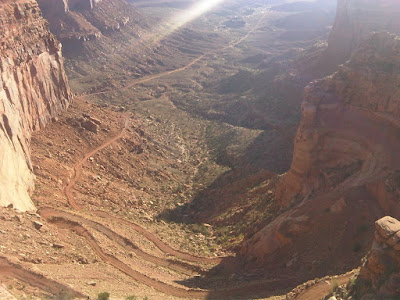
The second picture shows the Schafer trail, a road built to aid uranium mining activity, descending via torturous switchbacks to the White Rim. We drove this and many other similar trails, Long Canyon, Gemini Bridges (picture 3) and the Horsethief road to the Green River, returning at night to our tent and campfire at the Cowboy Camp.
I thoroughly enjoyed this mode of travel and would love to use a jeep to access the more remote regions of the park , but before we returned the jeep we crossed a line. Rather than use the vehicle as a mode of transportation we set out on a specific 4WD route, off-roading purely for the sake of it. This is a very common form of outdoor recreation hereabouts and many trails are multi-use with cyclists, 4 wheelers, dirt bikes and ATVs sharing the same trails. The reason I like mountain biking in Scotland is that it gets me away from motorists. Having a steady stream of buffoons and oafs blasting past would spoil the experience somewhat. When we climbed the 1000 ft from the Green River yesterday after an al fresco riverside dinner I drove past lots of cyclists who had been waiting for the cool shade of evening before starting their ascents. I felt a bit of a Clarkson-esque spoiler as I shot past them, coating their sweaty bald heads with red dust.
This feeling of having descended into a pit of depravity intensified as we revved and roared our way round the 4WD route in the Sand Flats Recreation Area (picture 4), just down the road from the famous Slickrock bike trail. I was surprised to learn that the Slickrock trail was originally a dirtbike route and is still used by them.
I have always viewed those who indulge in offroad driving as their main leisure pursuit with suspicion and disdain. My own dabbling today served to confirm and cement these views. I won't pretend that I didn't enjoy pointing my modified jeep up and down seemingly impossible gradients. That is, gradients that would have seemed impossible were it not for the trail markers and the wide strip of rock that had been blackened by the passage of thousands of tyres. This type off off-roading represents all that is worst in modern manufactured 'extreme' sports. When one stands back and looks at the big picture I spent fully 3 or 4 hours and covering just over 9 miles. Less than walking pace despite using tens of thousands of pounds worth of machinery a few gallons of unleaded. While the steep slickrock and the fast sandy sections were amusing, there was a lot of unpleasant, bone-jarring bumping over rough ground. I got my fill of that driving tractors in my youth. As paid employment it is tolerable, but as an expensive leisure pursuit?
The jeep has been handed back and we have readied the RV for the return journey to Las Vegas. Tomorrow we head to Monument Valley.

Labels: ,

Great Toilets of the World Part 2: Cowboy Camp

Living it up in the luxury of a house sized RV was getting too much. We needed a weekend off to get back to basics and reconnect with nature, so we threw the tent and an esky in the back of a hired jeep and made a break for the backcountry.
I found the toilet above at Cowboy Camp, just outside Canyonlands NP. We saw real cowboys nearby, with chaps and lassoos. One demonstrated his mastery of the equestrian arts by munching his way through a jumbo sized bag of Lays crisps without dismounting.
The toilet appealed to me as a study in minimalism, an exercise in adequacy. Both door and roof have been deemed unnecessarily luxurious and dispensed with, walls alone being enough to protect the decency of the occupant. The toilet paper was, however, permitted the shelter of a small roof, like that on a bird table, to protect it from occasional desert storms.
The Bureau of Land Management, who administer this and many other similar installations around Moab, do as fine job of keeping stray toleys in check as the cowboys do for steers. Before issuing permits for campsites without doorless dunnies like that discussed above they ensure that campers are packing their own sanitaryware. Paddlers on the Colorado and Green Rivers are obliged to accommodate their turds in their boats, like brown stowaways, for the duration of their trip. Perhaps they have to present them to the rangers at the end as evidence of their compliance in a smelly, twisted kit inspection, laying them out on a sheet as a fisherman would his catch at a village market on the Mekong. A shit inspection even.
Such bountiful provision of outdoor crapperies meant that I was deprived of the opportunity to practise the little known excrement disposal method of smearing, despite finding myself in precisely the unpeopled, arid desert environment for which its use is endorsed. I read of this method in a handbook of alpinism; one simply smears one's output onto a rock in as thin a layer as possible. The sun then dessicates the jobby into thousands of feacal flakes, very much like goldfish food, which are dispersed to the four winds, leaving the rock clean enough, in principle at least, to eat your dinner off of.

Labels: , ,

Sunday, 25 April 2010

Arches NP, Utah

Drinking the Polygamy Porter beer featured in the last post set me wondering about modern Mormons and their views on the practise. As is often the case, no sooner had the question been formed than the answer fell from the book I was reading.

Over 60 % of Utah's population are Mormons. Polygamy is illegal in Utah, yet there are an estimated 20,000 or so discreet polygamists. They have been excommunicated by the Mormon Church who no longer condone such activities. This amounts to less than 1 % of the state's population, roughly the same as the proportion of injecting drugs users in Scotland.

Shortly after leaving Capitol Reef we passed near Robbers Roost, the hideout of Butch Cassidy and the Wild Bunch. It is easy to see how he was able to evade the law, for this is remote country even now. We've had little contact with civilisation since leaving Las Vegas. So it was something of a shock to arrive in the town of Moab, gateway to Arches and Canyonlands NPs. The town dates back to the days of the old west but and was an important uranium mining centre, a legacy which has left the desert criss crossed with roads and trails that are now used for recreational purposes. Moab is now a mecca for outdoor enthusiasts, kind of the Fort William of Utah. Actually that is a ludicrous comparison.

The presence of so many enthusiasts has led to a tightening of camping regulations. This, combined with the introduction of an online reservation system for most but not all campsites, meant that in order to secure the plum campsite in Devils Garden pictured above we had to get up very early and wade through a deep mire of misinformation. It was well worth the effort, it is easy to escape the crowds even in the hugely popular Arches NP and the country, consisting of red sandstone that has been eroded into magnificent fins, spires and arches with spans of up to 100 m. It reminds me of the Olgas, a companion of Ayers Rock who hasn't aged so gracefully, but much more of it and with a better view.

Canyonlands next, watch this space.

Labels: ,

Wednesday, 21 April 2010

Capitol Reef NP, Utah

Prior to travelling I always try to minimise my exposure to pictures of my destination. If one has already seen a place through image and video the actual act of visiting can become a mechanical and rather soulless experience, a mere checking off of preconceived activities from a list. It is preferable to travel with an clean mind, open to fresh experiences.
Capitol Reef NP was not a place I knew anything about. Indeed it was only when it became clear that the drive from Bryce to Moab was longer than could be comfortably motorcaravanned in a single day that we decided to break the journey there. I am heartily glad that we did for it may well prove to be the highlight of this trip.
I have never seen colour so vivid. Just as blue light permeates from the bowels of a glacier, it is as if a deep red light illuminates the rocks of the reef from within, like a candle in a turnip lantern. The attraction is not just the utterly clean, sterile rock, laid out in licquorice allsort stripes of white, red and yellow; the lush canyon floors act as a counter balance, not just the vivid springtime green of the cottonwood and willow leaves, only a few days out the bud, but also that which is a lingering remnant of Mormon sweat. Fruita, which nestles below red cliff and grey mesa in the valley of the Fremont River, is one of many corners of this fantastic state that was settled and transformed by Mormon pioneers in the late 1800s. They levelled, tilled and irrigated fields and orchards that are still productive today.
It is in one such orchard, enclosed by fences of juniper wood, that the park campground is located. Pink and white blossom adorned the pioneers' fruit trees. The wind, hot from exposure to the baking rock, scattered it like confetti across the spacious riverside pitches. Green grass, like US Open semi-rough, provides running space for toddlers. For parents there are world class walks through surreal canyons and washes, onto the slickrock of the reef itself and through the orchards to view petroglyphs, marmots, mule deer and hummingbirds. All are accessed directly from the campground, making our three day stay relaxing and invigorating.
Evenings round the campfire were spent reading up on the geology of the reef and the settlement of Utah by the Mormon pioneers. I'd forgotten that they were hounded from a couple of locations in the east before embarking on their exodus to the valley of the Great Salt Lake. It's fascinating to think that as recently as 160 years ago it was possible to find sufficient space to settle a population of 14,000 persecuted polygamists. It's also humbling to think how hardy and self-reliant they must have been to create these oases in the desert - perhaps because they had no choice but to make new lives for themselves?
The only place that I can compare Fruita to is Muktinath, high in the Nepali Himilaya. It lies in the rain shadow of the range, yet the people catch the meltwater and grow crops in terraced fields, green jewels in otherwise barren desert country.
Note the amusing beer from the Wasatch Brewery - Polygamy Porter 'Why have just one?'

Labels: ,

Tuesday, 20 April 2010

Bryce Canyon National Park, Utah

When sitting in one's everyday rut it's tempting to think that everything would be better if one could be transported to a tropical beach or some faraway, exotic city. I'm fortunate enough to have visited enough of each to realise that travel isn't a silver bullet guaranteed to bring contentment or happiness; it's possible to be euphoric on a rainy day in Slough and jaded and grumpy while watching lions in the Serengheti. In principle at least, I've never actually heard of anything approaching euphoria being experienced in Slough. The point is that we project our inner landscapes onto our surroundings.
And so it was with Bryce Canyon. We arrived on Wednesday from Zion after what the presence of a grumpy toddler made seem like quite a long drive. The colours of the famous hoodoo rock formations were washed out by the afternoon sun, the campground was littered with dirty piles of melting snow, when we visited a viewpoint we were crowded by hordes of tourists. I couldn't muster any enthusiasm for a place that I had flown halfway round the world to see. All I saw was a reflection of my own tiredness and irritability.
Early next morning I made the short climb from the campground onto the rim of the canyon, panting in the thin mountain air. The place captivated me even before I had plunged my cafetiere or seen the first rays to light up the hoodoos, the eroded limestone formations for which Bryce Canyon is famous.
It is difficult to adequately describe the hoodoo without resorting to a technical description of their mechanism of formation, retreating into geological jargon. Nonetheless I will try.
The word describes a rock spire which, rather than tapering to a point or maintaining a uniform girth, has an uneven thickness, bulging in and out like a chess piece or the rear spars of a wooden dining chair. That such geometry is pleasing to the eye is evident from its widespread application in ornamental woodturning. To find oneself within a landscape that is entirely composed of such features is both exhilarating and intoxicating. This description of the hoodoo, though adequate, creates the false impression of the order and symmetry that results from precision lathe work. The hoodoos are organic structures, more akin to a patch of mushrooms than to banisters railings. It is this subtle variation within a repetitive framework that makes them as sublime to the eye as is a perfectly crafted house music track to the ear.
The same satisfying variation is evident in their colouring. A hoodoo that is white at its tip may merge to red in its middle portion and to purple near its base. They rise from aprons of hoodoo fragments, ridges of multicoloured cat litter. The subtle variations of earth tones are as exquisite as those found in the aboriginal rock art of Australia's Northern Territory. In both cases the framing is as important as the subject matter. In Bryce Canyon the hoodoos are framed between a deep blue high altitude sky and patches of leftover snow. They are garnished with the vivid springtime green of bristlecone pines and bathed in the clear clean light of the southwest. I am glad that I visited in the age of digital photography, I took so many pictures that the developing costs would bankrupt me.
Since leaving Las Vegas I have had no mobile network coverage. This post will be issued when I can scavenge sufficient wifi to unleash it. I'm now in Capitol Reef NP which promises to be even more spectacular that Zion or Bryce!

Labels: ,

Wednesday, 14 April 2010

Zion National Park, Utah

Mobile blogging from Utah's Zion National Park, basking in the spring sunshine. As you'll be able to tell from the photo we have hired a modest 'standard' RV (recreational vehicle). It may seem obscenely large but most others are much, much bigger.
We flew into Las Vegas, not due to any urge for gambling or other vice, simply because it is the most convenient airport for the delights of the southwest of the USA. One night staying on the 'strip' was plenty. Jetlag meant that we retired early, before our hotel's volcano's second eruption of the night. A jatlagged 2 year old meant that we took advantage of the 24 hour facilities - we were up for breakfast at 0500 and wandering the quiet and surreal streets shortly after. Groundsmen tended the lavish surrounds of the casinos, leather-faced winos prowled round hoovering abandoned drinks from the street. A few dedicated revellers still wore 3 foot long margharita glasses slung round their necks.
In a seedy parody of Panini football stickers cards with naked ladies in provocative poses lay strewn on the pavement, advertising 'specials' for between $35 and $85. One lay half-folded in a pool of partially dried vomit, the top half her body standing free of the pavement, surveying the sordid scene of carrot and margharita residue that surrounded her.
After passing the morning enjoying our hotel's dolphin pool and big cat enclosure we high-tailed it out of town, careering along roads only just wide enough to take our RV, arriving in Zion after dark. The three days here have been fantastic, the fresh green leaves and wildflowers of spring contrasting with the red and white sandstone cliffs. No big wall action or multiday backpacking on this trip, the highlight has been Erin walking her first mile since her hip operation, from the trailhead at the top of the canyon to the beginning of Zion Narrows. She tells me that she wants to climb the cliffs on her next visit. Think I'll wait until she's old enough to lead the hard bits and pull the haul bag.
Tomorrow we'll be hitting the road to Bryce Canyon NP. 4000 ft of elevation gain will take us from spring back to winter.
The second photo was taken during an early morning raid on Angels Landing. The ridge was exposed enough to be invigorating. The addition of chains made an easy scramble into a hard hike a la Half Dome. I had the summit to myself (apart from a chipmunk) and was glad to be on my way down before the first faffers started to gibber their way up the chains.

Labels: ,

Sunday, 13 September 2009

Alone in the Wild

Take one man, issue him with a camera, drop him in the midst of grizzly country and leave him there, fretting about the risk of bear attack, for three months. This is the wonderfully simple formula for the Channel 4 series 'Alone in the Wild', the first episode of which was broadcast on Thursday night.


California's High Sierra just after dawn


I found it compelling viewing, having experienced this primal bear fear at first hand while backpacking in California's Yosemite National Park. We had taken dehydrated food in order to minimise the weight of our packs, but my friend Mark was so horrified by the unmistakably vomit-like appearance of our Mexican chicken meal that he refused point-blank to eat it. As darkness descended I harangued him to consume his share, painfully aware that the scent of his uneaten food was wafting through the surrounding forest, acting as a beacon for any bears in the vicinity.

North American National Parks are as full of rules and regulations as they are of bears, and we had been well informed about bear danger. One must not keep any food or other odiferous items in the tent. There was no suggestion that a bear would be interested in food that had already been eaten, so they must be wary of the smell of people. There must, then, be a tipping point at which a bear's fear of humans is overwhelmed by its desire for food. I expect that a couple of pounds of pork links would do the trick, but what of more minor smells, such as that produced by the Mexican chicken that I had spilled down my front? Would that embolden a bear sufficiently to slash our tent canvas with his sharp claws and make off with my soiled shirt?


Half Dome from the approach


It was imperative to fill the bear cannister - a black plastic cylinder which the bears, lacking thumbs, are unable to open - and get it away from the camp. Our stuff wouldn't all fit in the box, so we put our non-food items - bug spray, soap, toothpaste, tobacco - in a stuff sack, which we hung half-heartedly from a puny tree. The unfinished food felt dangerous, like a cartoon bomb with a hissing fuse. We placed it on a boulder in front of the tent, then retired for an uneasy and broken sleep, unexpectedly tormented by bear-related thoughts. During the night I was woken by a loud bang vibrating through the ground. In my dozy stupor I attributed it to falling rocks.

In the morning bear tracks were evident all around. The audacious beast had even deposited a stool 20 feet from our tent. I realised with a start that the bump in the night had been caused by a bear resuming its four-legged stance after plucking our stuff sack from the tree. Gingerly, we followed a trail of chewed possessions until we found the shredded remnants of the bag. Perhaps the brute had been upset by a mouthful of mosquito repellent or tobacco, perhaps he had picked up the scent of our leftover food, every scrap of which had been carefully licked from the bag.


Bear attack aftermath


The chap on the programme, Ed Wardle,  recounted a story that a bear expert had told him just before he set out on his Yukon adventure. Two men were camping when a grizzly pulled one of them away, presumably with the intention of eating him. Cocooned in his sleeping bag, he was powerless to resist. Fortunately all ended well, his quick-thinking friend shot the bear dead. Even though my own encounters were with less ferocious black bears I am glad I didn't know that story at the time. I'm planning another trip to bear country next summer – hopefully by then I will have erased it from my memory!


Half Dome from Clouds Rest Summit


Half Dome. The cable route is visible to the left of the photo. Hikers are (just) visible near the top.

Labels: , , , , , ,

<data:blog.pageTitle/>

This Page

has moved to a new address:

http://livingmountain.net

Sorry for the inconvenience…

Redirection provided by Blogger to WordPress Migration Service